Seven nights, two beds, and the introductions it takes to reserve a Palio week in Siena
This is one of the five weeks in the catalog that do not exist without an introduction. Anyone may stand in the middle of the Campo for nothing, and if that is the whole plan, go and do it. But to reserve a Palio week in Siena is to arrive already known to somebody inside one of the seventeen districts.
- Starting figure, per person
$3,480
- Nights
- 7
- beds you will learn
- 2
- Country
- Italy
- How much of this you could arrange without us
- it does not exist without an introduction
Confirmed as a final figure once the supplier holds the dates. Getting to the country is not included.
- Whatever is agreed comes back to you in writing from the supplier, before any money moves.
- No card is asked for on this site and none is stored: the supplier takes payment on its own terms.
- A request sent through the form is answered in writing within one working day.
The part that counts against the office
Begin with the part that counts against us. The middle of Piazza del Campo costs nothing at all. You walk in through a gap in the wooden rail some time after noon, you stand on brick that falls about four meters from one side of the shell to the other, and at around five in the afternoon the gates shut and nobody comes out for the next three hours. No reservation, no intermediary, nobody here. If that is the whole of what you want, reserve your own rooms. You will manage it without us.
What cannot be arranged at arm's length is everything with a door on it. The long table that runs down a district's own street the night before, four hundred people at trestles under strung bulbs. The horse standing inside the district church at three the following afternoon while a priest speaks to it and tells it to come back a winner. A window on the second floor above the downhill turn, in a flat belonging to a family who have never advertised anything and are not about to begin. None of that is on sale. It is extended, by somebody known, to somebody they will answer for.
Two dates a year, and neither of them moves
The race is run twice, on 2 July and on 16 August, and those dates do not shift for anybody's holiday. Ten of the seventeen districts run each time: the seven that sat out the same race the year before, plus three drawn by lot at a public draw in late May and again in July, so the colors in the piazza are settled months ahead and not by you.
The four days before it are the reason to come for a week and not an afternoon. Horses are matched to districts by lot on the morning of 29 June or 13 August, and from that hour the town belongs to the trial runs: six of them, two a day, one just before half past seven in the evening and one at nine the next morning. Shops empty out for each, drums start in the streets, and the same few hundred people eat outdoors every night.
Weather, in plain numbers. Early July reaches about 31C by mid afternoon and drops to about 17C before dawn. Mid August sits nearer 33C, with several days a year above 35C. There is no shade in the middle of the piazza in either month.
Seven nights, two beds, and the reason for the second
Nights one to four are inside the walls, ten minutes on foot from the Campo, because the trials fall at nine in the morning and half past seven at night and you do not want to be driving in and out of a town whose center is shut to cars. The gates are watched by cameras, and a car left inside produces a fine by post about four months later. Bring one bag each that you can carry up brick on a slope.
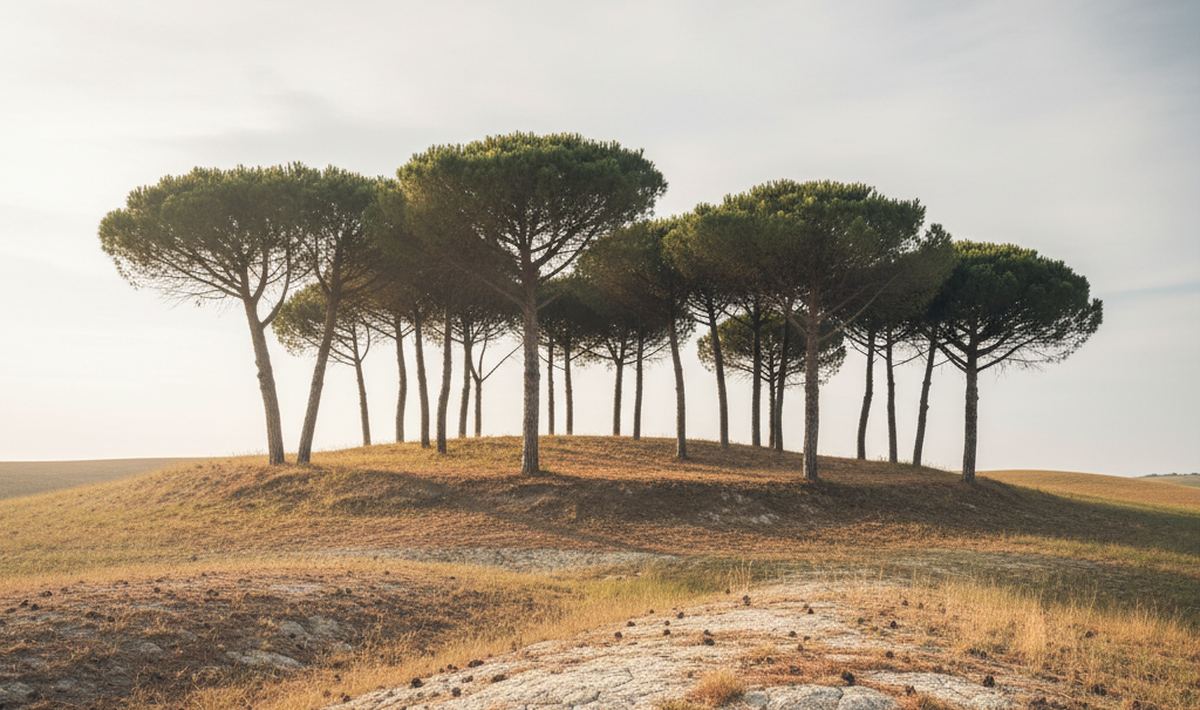
Nights five to seven are roughly thirty five minutes out, southeast into the clay hills, in a farmhouse with a kitchen and a door you can close. The town does not stop when the race does. The winning district sings in its own streets until about four in the morning for several nights running, and some people want to be inside that and some want to sleep an hour's drive from it. The second bed exists so you can decide on the day instead of in March.
Rooms inside the walls are quoted at race rates from the previous autumn. That is simply how the town works in those four days, and nobody there pretends otherwise.
Four hours of this ground, and what it does
For a few days a band of tufo, a packed mix of yellow earth and sand, is laid over the brick around the rim of the shell and banked at the two corners. One lap is about 333 meters and the horses run three of them, so the race itself takes something between 75 and 90 seconds. The corner where the ground drops and tightens has heavy padding lashed to the stone. The corner that climbs afterwards throws horses wide. Riders ride bareback, and a horse that has lost its rider can still win, which is the part visitors take longest to believe.
Standing in the middle is four hours of work. Once the gates close there is nothing to buy, no lavatory and no way out until the last horse is past. Take a hat, a litre and a half each in plastic, and no bag you would mind losing. People faint most years and are lifted out over the rail. If rain makes the surface unsafe the start is put back, sometimes to the following evening, and the whole town simply waits.
What the figure covers, and who it does not suit
From $3,480 per person covers the seven nights across both beds, the moves between them, and the arranged part: places at the long table the night before, and the approach made for a window above the track. Food beyond that one dinner is yours. The flying you sort out yourself, since no carrier has a contract with this desk and none ever will. The figure is confirmed when the rooms are held and moves with the date and the room.
Nothing is taken at this end and no card number is written down here. You settle with the people who house you and feed you, in whatever way they ask, and the office is paid afterwards out of a supplier's own margin, which is worth knowing when you weigh anything it tells you. Etre Super Travel is an independent agency in Kansas City, Missouri. The desk owns no aircraft, no rooms, no vessel and no tour program, and it belongs to nobody who does.
It does not suit anyone who needs the window settled before committing, anyone who cannot stand four hours in July heat, small children, or anyone who wants a still week in the hills. And plainly: horses fall at the corners and some are hurt. If that would spoil the week for you, take a different one.
Short answers to the usual doubts
Do you sort out the flying as well?
No. Getting to Italy sits outside what this office does at all. No seat on an airplane and no berth on a ship has ever been sold from this desk, and we hold an agreement with none of the companies that sell them. Your flights are yours to buy, in your own name, on whatever terms suit you. Tell us the day you land and roughly the hour, and the ground week is built around it: the rooms, the move between them, and the evening you need to be inside the district rather than on a road.
Can you promise us a window over the track?
No promise. Windows on the Campo belong to families and to the shops beneath them, and they are let by conversation, not by a form. The office asks in March for the July race and in May for the August one, and answers come back in weeks rather than minutes. Sometimes it is a second floor above the downhill turn. Sometimes it is a place at the rail in the middle instead, which costs nothing at the gate and is a very different afternoon. You are told which before anything is held.
What happens if it rains?
The race waits. If the surface is judged unsafe the start is put back, sometimes by an hour, sometimes to the following evening, and that call belongs to the town rather than to anyone you can telephone. Rooms are held on the assumption that the week has a spare day inside it, which is one reason the shape is seven nights and not four. If the race slides by a day, the country nights lose one and the office moves the transfer to match.
We only want to watch the race. Nothing else.
Then this is not your week and you should not take it. Reserve two nights of your own inside the walls, or a night out of town and a coach in, walk into the middle of the Campo by two in the afternoon and stand. It costs nothing at the gate and it is a real way to see the thing. What the office adds is the four days on either side and the doors that open only for somebody known. Without those, you would be paying for rooms you can reserve yourself in an evening.