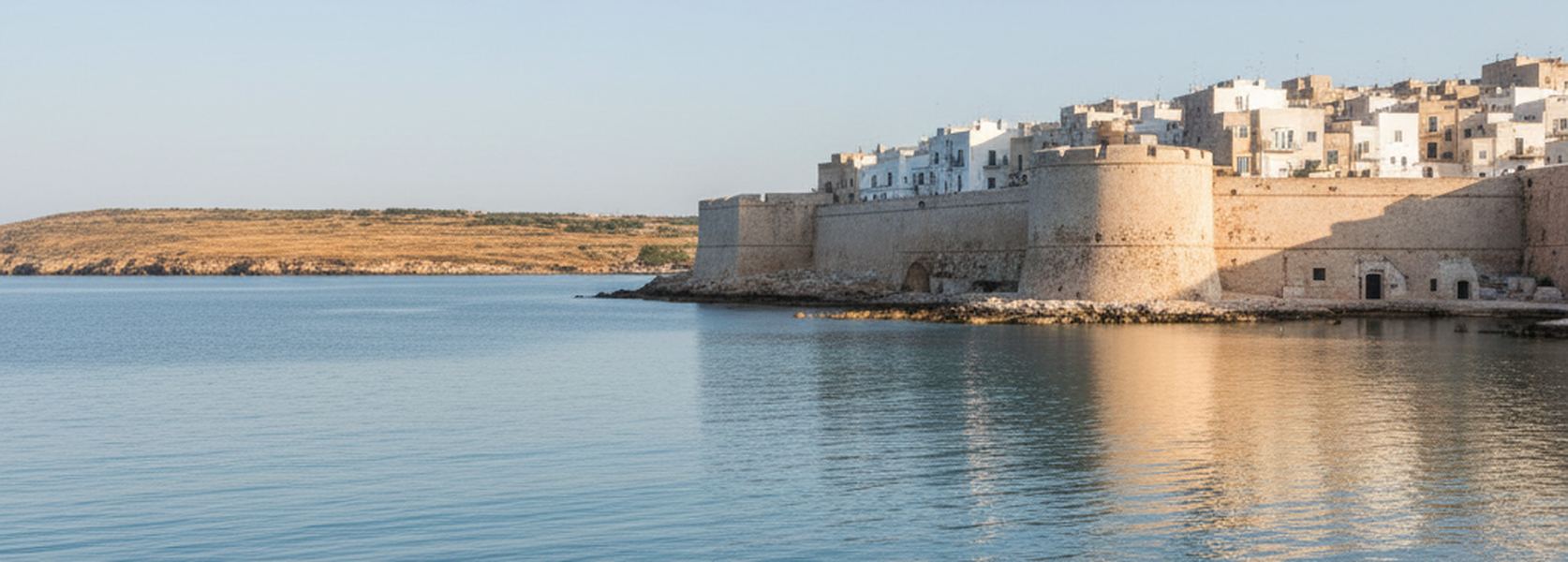
Two towns, one branch railway between them, and how to reserve an eight night trip to the Apulian heel
Lecce for four nights, Otranto for four, and about 45 kilometers of flat limestone between them. You could reserve an eight night trip to the Apulian heel yourself, and the first section of this page says so before it says anything else. What we would still be doing is reading two sets of cancellation terms and holding the file.
- Starting figure, per person
$2,190
- Nights
- 8
- beds you will learn
- 2
- Country
- Italy
- How much of this you could arrange without us
- you could arrange all of this yourself
Confirmed as a final figure once the supplier holds the dates. Getting to the country is not included.
- Whatever is agreed comes back to you in writing from the supplier, before any money moves.
- No card is asked for on this site and none is stored: the supplier takes payment on its own terms.
- A request sent through the form is answered in writing within one working day.
There is no door here that needs opening for you
Straight out, before the pictures do any work: you could arrange all of this yourself. On the four step scale this catalog sorts by, this week sits on the first step, and that is the step where we tell you to keep your money. There are two beds to reserve, one small car to hire, and a branch railway whose timetable is published. Both houses answer email in English inside a day or two. Nothing here needs an introduction from anybody, and nobody is holding anything back from you.
So what would we be doing. Two houses means two deposit rules and two cancellation windows, which we read and set side by side on one sheet, so you can see which one hurts if April goes wrong. One file rather than two threads. And when a room moves, one message in Italian sent at an hour when someone is at a desk in Lecce, not at eleven at night in Kansas City. That is the whole of it. If you enjoy this part, keep it. There are weeks further along in the catalog where the answer is different, and we will say so there too.
Flat limestone, dead olives, and forty five kilometers
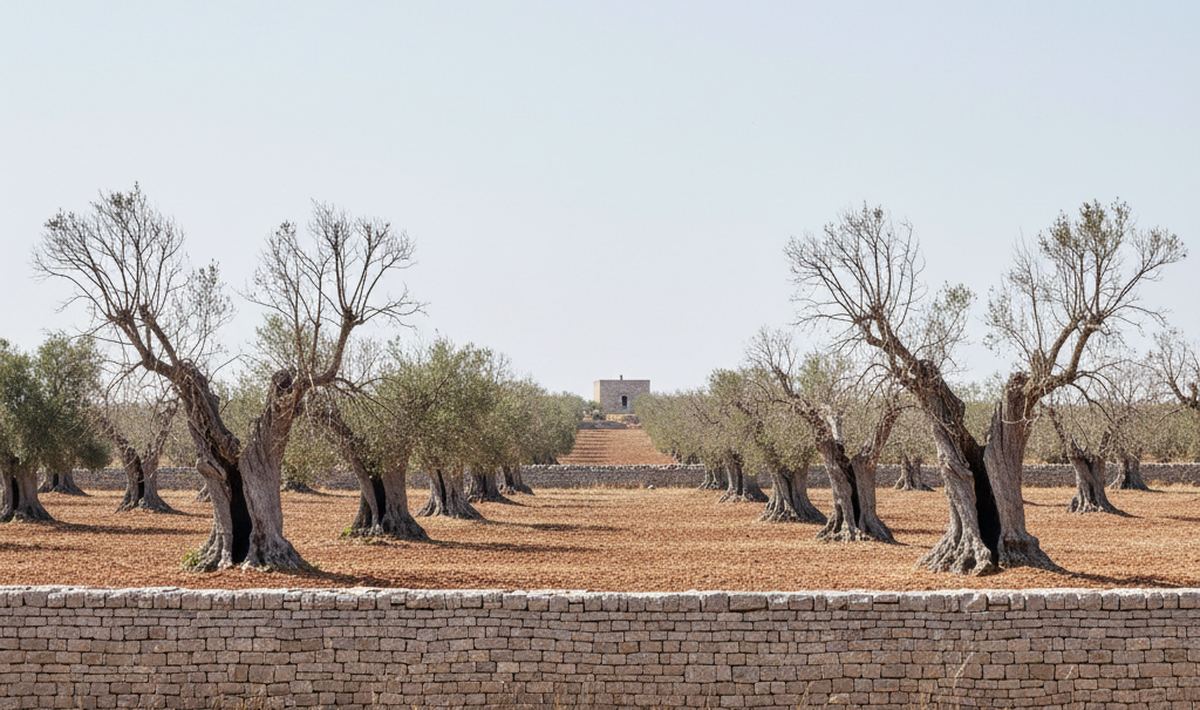
The heel is flat. The ground never gets far above 150 meters, so what you notice is not height but surface: limestone under a thin red soil, dry stone walls stacked without mortar, and fig trees growing out of the joins.
The olives are the part nobody mentions. A bacterium carried by a sap sucking insect turned up near the west coast in 2013 and has since killed olive trees across the peninsula in the millions. Whole groves stand as gray skeletons with split trunks; some plots have been cleared and replanted with varieties that tolerate it, others left as they fell. It is a working landscape in the middle of a slow disaster, and it is fair to know that before you drive 40 kilometers through it.
The towns are about 45 kilometers apart, near fifty minutes by car on the inland road. The branch railway takes an hour and a quarter to an hour and forty, usually with a change at Maglie, a handful of departures a day and fewer on Sundays. South of Otranto the coast turns to cliff and switchback for 20 kilometers. North of it there are two brackish lakes and pine behind the sand.
Lecce, and what four nights there consist of
Lecce holds about ninety five thousand people, and the walled part you will walk is roughly a kilometer across, paved in stone that four centuries of feet have polished slick. The local limestone comes out of the ground soft enough to cut with a knife and hardens in the air, which is why the seventeenth century carving goes so deep. The front of the basilica off the main street, finished in 1646, is a wall of fruit, beasts and figures around a rose window; you can stand under it for twenty minutes and keep finding things.
Under the main square, four or five meters below the paving, sits a Roman amphitheatre with about a third of it dug out and the rest still under the buildings. It held something in the order of twenty thousand. A smaller Roman theater hides three streets away.
The days have a shape imposed on them. Shops and most churches shut from about half past one until five, dinner starts at half past eight, and the squares fill after that. A combined ticket for several churches runs near eleven euro. Breakfast is a small shortcrust pastry filled with custard, from a town twenty kilometers south, about a euro sixty at the counter.
Otranto, the mosaic floor and the road south
Otranto has about five thousand seven hundred residents and an old town you cross in five minutes. The cathedral floor is the reason people come: a mosaic laid between 1163 and 1165 by a local priest, running the length of nave and aisles, a tree of life with elephants at the root and, worked into the branches, the labours of the months, Alexander the Great and King Arthur, of all people. It is under your shoes and nobody stops you walking on it. In a chapel behind the altar are the bones of roughly eight hundred townspeople killed after the siege of 1480, stacked in glass wall to wall. The two things stand ten meters apart.
Four nights is more than the streets need, which is the point. Five kilometers south, up a road that gives up its tarmac near the end, is the easternmost point of the country and its lighthouse; on a clear morning the mountains across seventy kilometers of water stand up in full. Two kilometers out is a worked out bauxite pit, red walls around a small green pond, quarried until 1976, fenced off and reopened more than once, so check on the day. The cliff road south runs past sulfur springs to a fishing town in a cove.
Months, money, and who this week is wrong for
The figure is from $2,190 per person across the eight nights. It covers both beds with whatever breakfast each house serves, and the road transfer from the airport at Brindisi into Lecce on the first day. It does not cover your own flights, the car for the second half, lunches, dinners, the church ticket or fuel. A small hire car in shoulder season runs 35 to 45 euro a day, and fuel sits near one euro eighty a litre. The final figure is confirmed when both houses confirm, and nothing is reserved until you have seen the new number.
Months, plainly. May sits at 23 or 24 degrees. July and August run 31 to 33 with humidity off the sea and the old towns full from six in the evening. Late September into early October holds 25 to 27, with the water near 24. November and December are the wet months. January days are around 14 and much of the coast is shut.
It suits adults who will drive walled lanes, eat at half past eight and walk on uneven stone. It does not suit anyone who wants a lounger and a lido for a week, anyone who needs level ground, or anyone who wants a new town every night. That last one is a different shortlist and we will point you at it.
Short answers to the usual doubts
Do we need to hire a car?
For the Lecce half, no. The walled center is closed to visitor traffic and the car parks sit outside it, so a car would spend four days idle and charge you for the privilege. For the Otranto half, yes, if you want the lighthouse road, the old quarry and the cliffs going south; the local bus exists, but its timetable is built around schools and markets. Reckon on 35 to 45 euro a day in shoulder season for something small, and expect stone walls on both sides of the lane with no verge to pull onto. If nobody wants to drive, take the branch railway between the towns and let the coast road go. That is a real option, not a consolation.
Is August a mistake?
It is not a mistake, but know what you are buying. Highs of 31 to 33 degrees with humidity coming off the sea, the old towns full from six in the evening, room rates at their yearly peak, and the sand north of Otranto claimed by mid morning. If what you want is the two towns and the coast road without a queue for every parking space, the back half of September sits at 26 to 27 degrees and the water is still near 24. We will reserve August if August is when the leave falls. We will just put the numbers in writing first.
Will you sort the flights, and can you advise on visas or travel insurance?
No, none of the three. The flying is outside what this desk touches at all, so choose it, hold it and change it as you please. Send the dates you settle on and the ground gets built around them. Visas, passports and anything to do with entering a country we do not handle and will not comment on, in either direction. Travel insurance we neither sell nor recommend, and we will not tell you which one to buy. That is three refusals in one answer. They are the ones we can stand behind.
When do we pay, and do you hold a card?
You pay each house directly, on its own schedule, and no card number ever reaches this office. The deposit goes to whichever place you are sleeping in, on the terms that place sets, and the paperwork that comes back carries its name and its tax number; we are not a party to it. What we earn arrives afterwards and from the other side of the arrangement, once the stay has happened, and it does not sit on top of the figure you were quoted. The number you see is the number the house is charging. If a deposit falls due before your dates are certain, say so and we will ask for a hold instead of a payment.