Three questions later, you can reserve a short-day walking week in Europe
The group is built around one person who cannot manage a long day on their feet, and cannot manage a climb at all. That answer, given three questions ago, is what leaves four weeks out of thirty-two. Reserve a short-day walking week in Europe from any of them, or take the honest number printed beside each and decide that two of them need no office at all.
- Flat ground along the middle Loirefrom $2,260 per personyou could arrange all of this yourself
- Level tracks on the Veluwefrom $2,080 per personyou could arrange all of this yourself
- The Po plain at walking pacefrom $2,200 per personyou could arrange most of it yourself
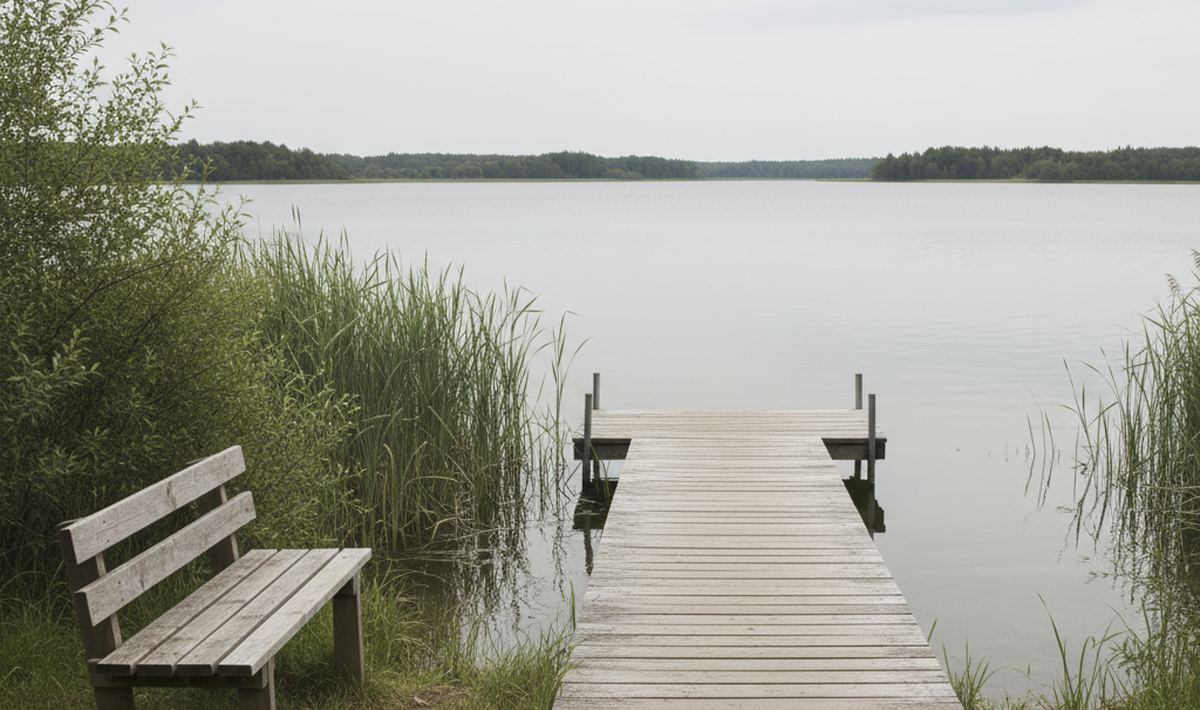
- Boat and bench in the Mecklenburg lakesfrom $2,480 per personyou could arrange most of it yourself
One unbroken stroke means you could do all of it yourself. Four pieces mean it does not exist without an introduction. The written words beside the mark say the same thing, so the mark never carries the meaning alone.
Any day here can be halved at eleven in the morning
All four are flat. That is why the questions ended here, and it is not what makes them work. What they actually share is that each one can be cut in half at eleven in the morning without the rest of the week coming apart. You sleep in the same room for three or four nights at a stretch, so a day nobody walks costs a day and nothing else. Luggage moves twice on the Loire and on the Po, once on the Veluwe, and in Mecklenburg it stays where it was put down. Every walking day begins and ends within about two hundred yards of the bed, so the morning does not open with a transfer and the evening does not close with one. And in each of the four, somebody has been along the route counting places to sit: benches, low walls, chairs outside a village bar, the dry end of a jetty. That count is the reason these four are in this corner of the catalog and why several other flat weeks are not.
Where the four part company
They differ in what happens on the day that goes wrong, and that is the difference worth holding. The Veluwe runs on hard sand and asphalt cycle track, so a wheeled frame rolls and a chair can be pushed; it also crosses open heath where there is nothing for two hours and no vehicle can reach you in the middle of it. The Loire towpath is compacted gravel that softens at the edges after rain, and a road stays close to it nearly the whole way, so somebody can be collected from most points inside twenty minutes. The Po plain puts a village about every two miles and a bar in each one, but the surface is farm track, with ruts and a strip of grass down the middle, and the family at the inn may answer the telephone in Italian only. Mecklenburg hands part of the walking to a lake boat on a public timetable, run by a local company, tickets bought at the landing stage rather than here, so a whole day can be spent sitting down; it also means that between two landings you are on water and cannot change your mind. Eight nights, nine, nine, ten. From $2,080 to $2,480. The nights and the money are not where these four come apart, and we are not going to tell you which one is yours.
What goes wrong here, and the number printed against us
The trouble in this corner is rarely the ground, it is over correction. Somebody decides the person the week is built around should not walk at all, reserves a week of coach seats and dining rooms, and by the fourth day that person is being handled instead of traveled with. The other one is arithmetic: flat is not short, and nine miles on a level towpath is still nine miles. So two things are asked for before anything is held. That the person it is built around speaks or writes for themselves rather than being reported on, and a distance they can do on an ordinary day rather than on a good one.
Then the number printed against ourselves. The Veluwe week and the Loire week you could each arrange at a kitchen table in one evening: trains, a marked route, guesthouses that take reservations online in English. Reserve either yourself. Write to us anyway and the bench count and the two places where the surface changes will be sent to you. The Po plain is most of it yourself, less the driver in a village of nine hundred people who has to be found by telephone, in Italian, at an hour when somebody is in the kitchen. Mecklenburg is most of it yourself as well, less two ground floor rooms on the water that a small guesthouse keeps off the reservation screens.
Before you pick one of the four
You have just told me to reserve one of these myself. How do you get paid?
By the places that run the weeks, and only after you have been. You settle with them, in their currency, on their own paperwork; nothing is charged here and no card number is typed on this side of the desk. That is also why the advice on the Veluwe costs you nothing to take. Arrange it yourself and we earn nothing on it, which is the point of printing the number at all: we would rather be believed on the other three.
How do you know the ground is really flat?
Because somebody walked it and wrote down numbers. Height gained across a day, the surface underfoot and the two or three points where it changes, the gap in miles between one place to sit and the next, and how close a road comes. The same list goes to each supplier every season, because a towpath resurfaced in March is a different towpath in September. What we cannot tell you is how any of it will suit a particular person. We describe ground, not people, and we give no medical opinion of any kind.
Somebody may need to stop at eleven in the morning. What then?
That is settled before you go. Every day in these four has a way out written into it: an hourly bus, a road a car can reach, a lake boat on a public timetable with tickets bought at the landing stage, or a room you have not checked out of because you sleep in it again tonight. The way out goes into the paperwork you carry, in plain words, with the numbers of the people who answer locally. Getting to Europe and home again is yours to arrange; this office reserves nothing that flies or sails.