
Ask this before you reserve a vacation week in or out of high season
Your dates were handed to you by a school term, a wedding or a shift rota, so there is one thing to settle before any of the rest: whether to reserve a vacation week in or out of high season. The answer reorders every decision that follows, and it changes how much of the week you could arrange without us.
Why this question goes ahead of the others
Every other question on this site can be answered twice. Sea or mountains, a city or a village, one base or three: change your mind in March and the answer still works in September. The season is not like that. It is a property of the place on the calendar you were handed, and you were handed it by a school term, a wedding, a shift rota or somebody else's leave. Almost nobody arrives at this page having chosen their dates freely.
So the first thing the office does is find out what your dates mean where you want to go. The busy weeks are a local fact and not always the obvious month: a fortnight around a religious holiday, the six weeks a river runs high enough, the ten days the vines are picked, the month half a country stops work. Two towns forty miles apart can disagree about it.
Once we know which side of that line your dates fall on, the shape of the week is largely settled. Everything after this fork is detail. Everything before it was arithmetic you had already done.
If the dates land in the busy weeks
Say yes and the order of your decisions turns over. In the busy weeks the place is awake: kitchens staffed, the small museums keeping long hours, buses on the summer timetable, and you can be casual about lunch. What you cannot be casual about is a bed. Lodging stops being the last thing you settle and becomes the first, because the rooms that actually suit you, the one with two real beds rather than a sofa, the ground floor one, the pair that adjoin, make a short list, and other people are working from the same list in January.
Downstream that shows up in the honest number printed against every week. In the busy weeks more of it slides toward the two harder steps: the half that needs a telephone call, and the part that does not exist without an introduction. Not because the arrangements are elaborate, but because the reply to an email in July is no, while the reply to a call from a voice the owner already knows is sometimes not.
People arrive at this door braced for crowds. They ask us about queues, and we usually end up answering about beds.
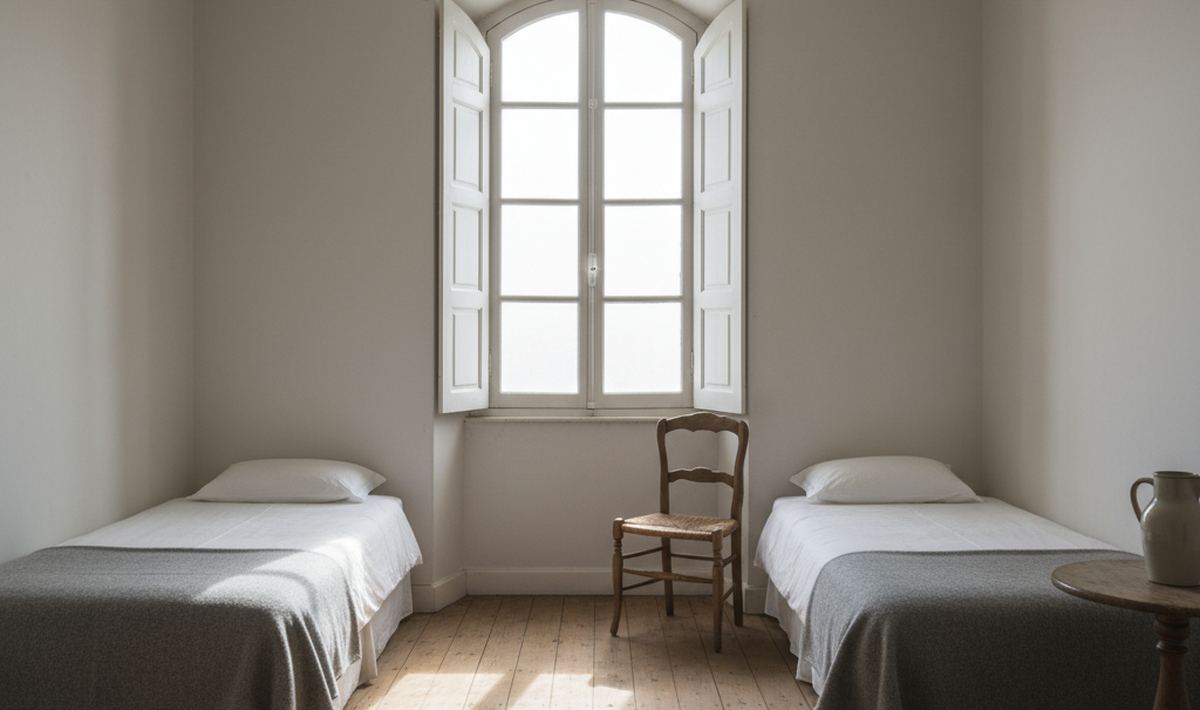
If they land in the quiet ones
Say no and availability stops being the problem. You can decide on Tuesday what you are doing on Wednesday, and in spring the room you wanted is generally still there. The constraint moves to whether the thing is open at all: a museum keeping three days a week, a kitchen shut for its annual month, a pass road closed until the plow has been through, a market still running with half its stalls. Very little of that is published anywhere, and all of it is a telephone call.
This is also where the honest number tends to sit at the easier end. Plenty of quiet weeks are ones you could assemble yourself in an evening, and when that is true we print it on the week and mean it. We would rather tell you that than take a reservation for work you have already done. The quiet weeks we do earn are the ones where a single closure would have hollowed out the whole trip, and somebody had to ring and find out which of your two dates it fell on.
People who pick this door chose it deliberately and are seldom put out by rain. What puts them out is a shutter.
Asked before you commit
I know my own calendar. How am I supposed to know whether it is the busy season there?
Most people cannot, and that is fine; it is the part we look up first. The busy weeks are set locally and often by something other than weather: a saint's day, a harvest, a school calendar two countries away, a festival that fills every bed for nine days and empties the town on the tenth. Tell us the dates you are stuck with and the country you have in mind, and the answer usually takes a morning. You pick the door after that, not before.
My date cannot move at all. Does this fork still matter?
Yes, and mostly because it cannot move. The fork is not asking you to shift your week; it is asking what your week already implies. The answer decides what we do first, how early we have to do it, and how much of it can be done at all. A fixed date in the busy weeks means we start with a bed in winter. The same date in the quiet weeks means we start with a list of telephone numbers and a set of opening hours.
What if my dates sit on the line and fall in both?
Often, and shoulder edges are the reason people write to us at all. A fortnight can start in one and finish in the other, and the two halves behave differently. We plan the whole thing to the stricter of the two: beds treated as though the busy weeks apply throughout, opening hours checked as though the quiet ones do. It costs a little more work at the front and it stops one half of the trip from being planned on the wrong assumption.