Walkers who want the high traverse can reserve a walking week in the Picos de Europa
Three beds and nine nights, three of the days spent crossing the limestone, from $2,880 per person. This one lands on the third of our four steps, where the hard half needs a telephone call and the easy half really is easy. Reserve a walking week in the Picos de Europa through this office, or ring the huts yourself; we will say which parts are which.
- Starting figure, per person
$2,880
- Nights
- 9
- beds you will learn
- 3
- Country
- Spain
- How much of this you could arrange without us
- the hard half needs a telephone call
Confirmed as a final figure once the supplier holds the dates. Getting to the country is not included.
- Whatever is agreed comes back to you in writing from the supplier, before any money moves.
- No card is asked for on this site and none is stored: the supplier takes payment on its own terms.
- A request sent through the form is answered in writing within one working day.
What you could arrange without us
This week lands on the third of the four steps the catalog is sorted by, which is to say the hard half needs a telephone call. The steps run from a week you could set up in one evening to a week that does not happen unless somebody vouches for you, and printing where each week sits is the only method we have found of keeping ourselves honest about what we are for.
The easy half is honestly easy. The valley guesthouses take online reservations a year out and answer email in English. The cable car sells its own tickets at the bottom station on the morning. The gorge path is public and free and needs nothing from anybody. Buses reach both valleys from the coast.
The hard half is two mountain huts and one road. The larger hut holds 96 people at 1,953 m and is full for August by about March. The small one on the plateau has six bunks and a warden who picks up a telephone in the evening, in Spanish, if he happens to be inside. Then there is your luggage, which has to be driven roughly 100 km around the massif while you walk 20 km across it, and a taxi waiting where a gorge ends 130 road kilometers from where it began. Those are the parts people abandon at eleven at night.
Underfoot, from the first morning
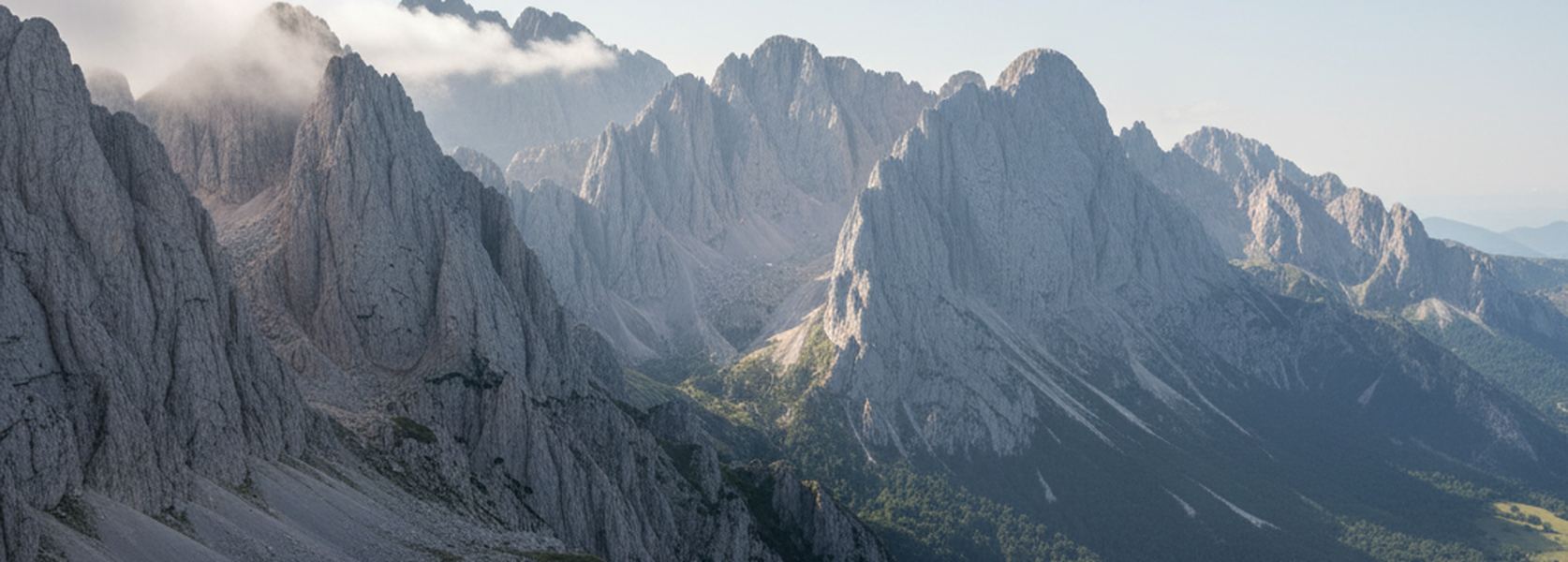
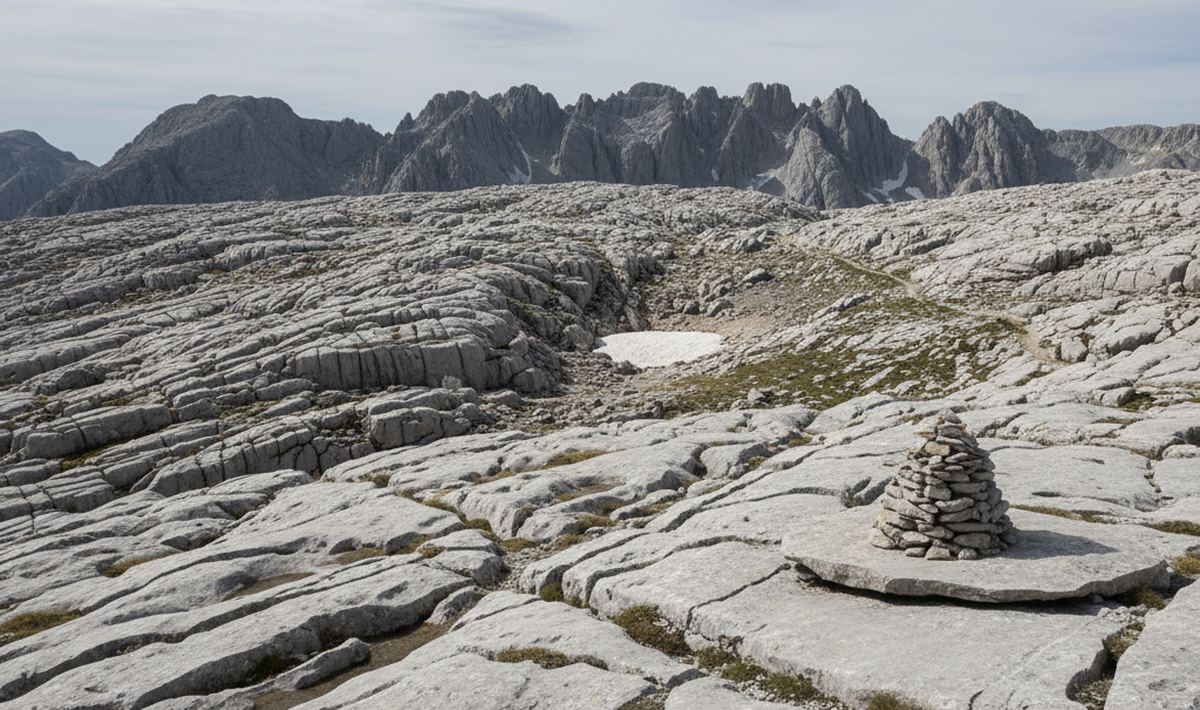
The range stands about 20 km inland from the Bay of Biscay, which accounts for the green valleys and for the weather. Three limestone massifs, split apart by gorges; Torre de Cerredo reaches 2,650 m. Between roughly 1,800 and 2,400 m the ground is bare karst: pale gray, fissured, drilled through with holes, carrying no soil and no water at all. You walk on rock for five or six hours at a stretch. There is nothing to drink between the upper station and the hut, so you set off with three litres each and finish them.
Route marking on the plateau is cairns and painted flashes rather than a worn path. On a clear day it reads itself. In cloud, and cloud settles there often, the karst looks the same in every direction, and walkers lose an hour hunting for a gap they have already passed twice. Snow sits in north facing gullies into early July. The rock is sharp enough to open a palm and greasy when wet.
Drop below 1,500 m and it changes entirely: beech wood, hay meadows cut in July, stone villages where a van brings the bread up at nine.
The three days, one at a time
Day one starts at the bottom cable car station at 1,070 m. The car climbs to 1,847 m in about four minutes and takes twenty people, and by ten in the morning in August the queue runs an hour, so you go up on the first car with the workmen. From the upper station it is 13 km to the hut under the west face at 1,953 m, with 700 m of climbing and 600 m of descent, six to seven hours at a walking pace with stops. The high point is around 2,300 m, beside a hut the size of a garden shed that was built out of a warship gun turret and sleeps six.
Day two goes down. Nine kilometers and 1,300 m of descent through a village that has no road, reaching the valley at 645 m in four to five hours. It is a day about knees rather than lungs. A funicular runs 2.2 km through the rock in seven minutes if the knees have finished early.
Day three is the gorge: 12 km each way along a ledge cut for a water channel a century ago, a meter and a half wide in places, a hundred meters of air below, no shade, no railing for long stretches, about 500 m of cumulative climb. Almost everybody walks it one way and takes the taxi.
Nine nights, three beds
You reached this week through three questions rather than a list, and the shortlist it came out of was built around somebody who walks all day. The nine nights split three ways.
Nights one to four are in a stone house at about 900 m in the south east valley, with two gentle days first: a meadow walk, and the market town on Monday, when the square fills with cheese, boots and secateurs. Night five is the hut at 1,953 m. Half board, a blanket on a mattress in a room of thirty, no towel, no shower worth the word, lights out around ten, breakfast at half past six because the guide wants you moving while the rock is still cold.
Nights six to nine are in a village at 645 m on the north side, where the walking is done and the days are the gorge, a cheese cave dug into the hill behind, and a chair in the shade. Two of the nine days are deliberately empty. People who fill every day of a week like this one tend to go home tired in the wrong way.
What it costs, and who should not go
From $2,880 per person. That covers nine nights of beds, breakfast in both valleys, half board the night in the hut, luggage moved twice around the massif, the road transfers at each end of the crossing, the taxi at the far end of the gorge, and a local mountain guide for the two high days. It does not cover your own flights or the drive from wherever you land, lunches, dinners in the valleys, the cable car, which runs about 20 euros return, or anything you buy in a shop. The figure is a starting point. The total is confirmed once the suppliers confirm, and you see that number before anybody is committed to anything.
It suits a person who can walk 20 km with 900 m of ascent on consecutive days carrying a day pack, sleep in a room of strangers, and be turned back by weather without sulking. It does not suit anyone who wants a private bathroom every night, anyone whose knees dislike long descents, anyone who needs the itinerary held whatever the cloud does, or children much under fourteen.
Short answers to the usual doubts
What about the flights themselves?
No. We sell no seat on an aircraft and no passage on a ship, and we have no agreement with anyone who operates either. Your flights are your own affair. Tell us the day you land in northern Spain and the day you fly home, and the ground is built between those two dates. If your arrival moves, say so and the first night moves with it. That is the whole of our dealings with aeroplanes.
Can we walk the high days without a guide?
Plenty of people do. Nothing on the route is technical: no rope, and no scrambling beyond a hand on rock at two steps. The awkward part is navigation on bare karst with the cloud down, where a compass and a bearing are genuinely required and the ground gives no clue at all. A guide for the two high days sits inside the quoted figure. Ask, and we will price the week without one and tell the huts you are coming under your own steam.
What happens if the massif is under cloud on the crossing day?
You do not cross that day. The guide decides the evening before and the decision is his to make. If the hut has room the night shifts; if it has none, you walk a valley instead and the crossing becomes two days rather than three. We promise nothing about the sky. July and August each bring roughly eight days with rain to this range, and cloud often arrives off the coast in the afternoon. Plan on losing one day and the week stays pleasant.
Who takes the money, and what do you make on it?
You settle with the people who actually feed, house and guide you, on their own terms and in their own currency. Nothing is taken at this end: no deposit, no card kept on file, no number typed into anything here. Our income turns up afterwards, as commission paid by the suppliers who accepted the request, which is why the figure is the same whether you use us or spend three evenings on the telephone yourself. Where a supplier pays no commission, we say so and you go direct.