Unpack once for nine nights and reserve a Lent week in the Umbrian hills
Nine nights in one hill town between Ash Wednesday and the middle of Lent, one bed throughout, from $2,040 per person. This week sits on the first of the four steps: all of it is yours to set up in an evening. If you would rather reserve a Lent week in the Umbrian hills through an office anyway, here is what ours would actually be doing.
- Starting figure, per person
$2,040
- Nights
- 9
- beds you will learn
- 1
- Country
- Italy
- How much of this you could arrange without us
- you could arrange all of this yourself
Confirmed as a final figure once the supplier holds the dates. Getting to the country is not included.
- Whatever is agreed comes back to you in writing from the supplier, before any money moves.
- No card is asked for on this site and none is stored: the supplier takes payment on its own terms.
- A request sent through the form is answered in writing within one working day.
You could arrange all of this yourself
That is the number this week carries, it does this office no favours, and it is printed early for that reason. The apartment takes reservations direct and answers email in English inside a day. The car is a form on a website. A train from Rome reaches the valley in about ninety minutes, eleven or twelve times a day, for something close to twelve euros in second class if you buy it at the machine instead of the counter. Nobody in a town of eight hundred people needs an introduction from Kansas City before handing you a set of keys in February.
So do it yourself. If you like that part of a trip you will do it well, and you will keep the afternoon we would have spent. What this office is for, if you want it at all, is narrower than a reservation. Lent moves by more than a month from one year to the next and drags every closure with it. Winter timetables for small museums are often a sheet of paper taped inside a door. A house that looks central on a map can sit forty minutes and two dozen hairpins from the things you came for. We check that, put the request to the owner, and are paid later out of the supplier's margin. If none of it is worth an afternoon of yours, you have your answer already.
Fog below, sun above, and the ground you actually walk on
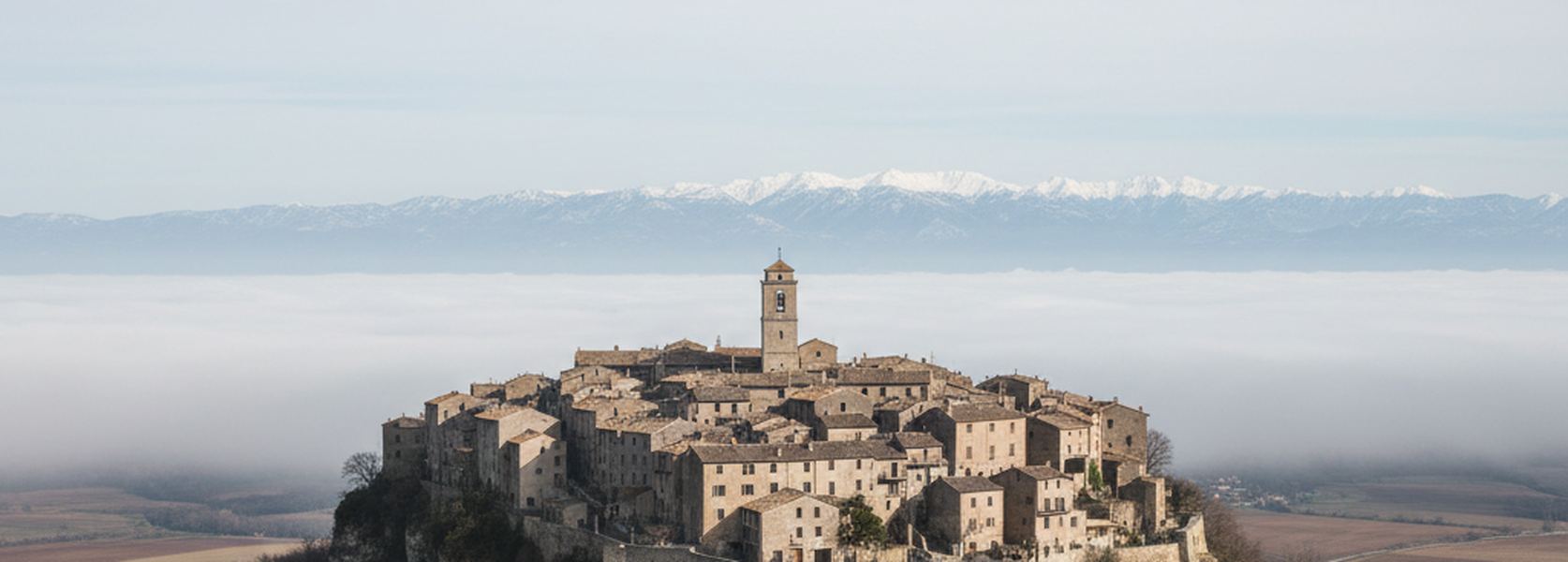
The Valle Umbra is a flat floor at about 200 meters, with hill towns pinned along its eastern rim between 300 and 500, and the Apennine ridge standing behind them past 1,500. Most February mornings the floor fills with fog and the towns sit above it in sun, which is convenient if you are staying up there and a nuisance if you are driving in.
Numbers, since they are more use than adjectives. Daytime temperatures run 10 to 13 degrees Celsius, roughly 50 to 55 Fahrenheit, and drop to 1 or 2 overnight. Stone houses hold the cold, and heating is often a wood stove plus one radiator that takes an hour to argue with. Expect nine or ten days of rain in the month, usually an afternoon of steady gray rather than a storm. Snow lies above 800 meters into March and the roads over the passes to the east can shut for a day without notice. Sunset is about a quarter to six in mid February and about a quarter to eight by the end of March, so the usable day is short at the start of Lent and long at the end of it.
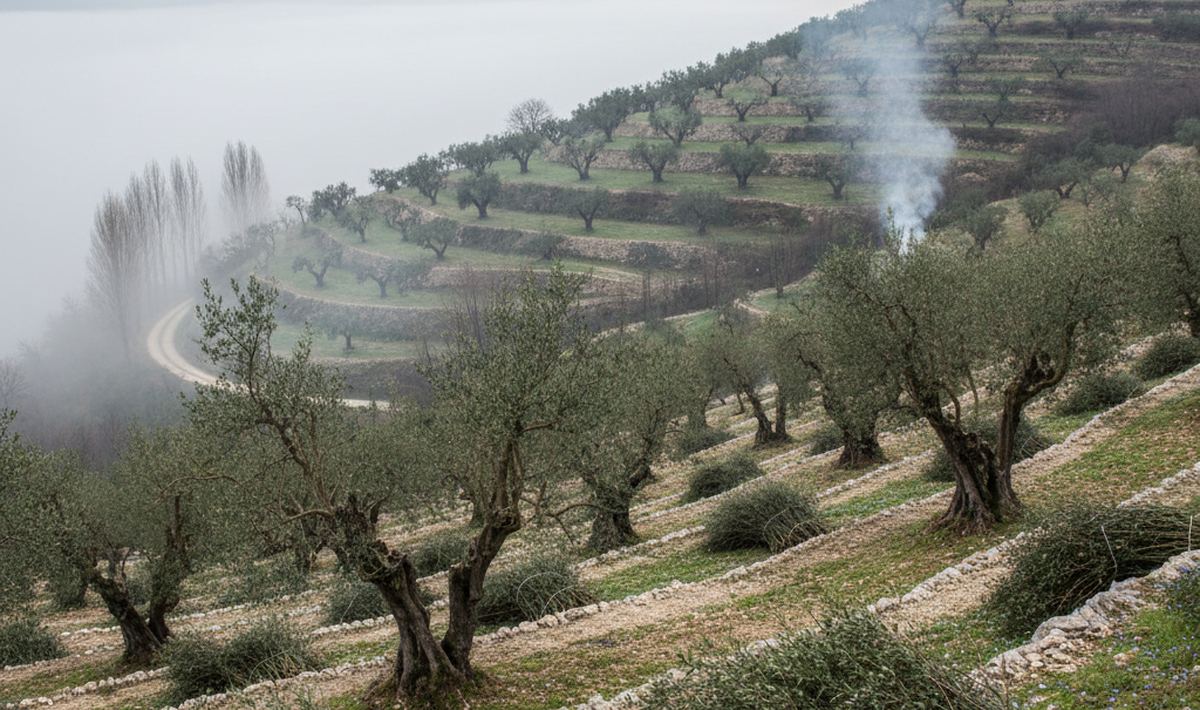
The hillsides are pruned while you are there. Cut olive wood is stacked at the row ends and burned in the afternoons, and the smoke settles into the valley with the fog.
Nine nights, one bed
One bed for nine nights means you unpack once, and it means the week can lose two days to weather without feeling robbed. The base is a two room apartment on the upper floor of a stone house inside the walls of a small town, about 55 square meters, reached by an outside staircase of roughly twenty steps and then a second flight indoors. There is no lift and there will never be one. A kitchen that works, a wood stove with wood beside it, a washing machine, and windows that look at other people's roofs first and the valley second.
Parking sits outside the gate, between 150 and 300 meters downhill, and you carry the bags the rest of the way. In February the space is usually empty. In the week before Easter it is not.
A day tends to go like this. Out on foot before the shops shut at one, or into the car for twenty five to forty minutes; a lunch that ends around three; an hour of something with a roof over it; back up the hill before the light goes. Two of the nine days will be spent doing very little while it rains, and that is the argument for nine rather than six.
Distances, opening hours and closed doors
Nothing here is far and everything takes longer than the kilometers suggest, because the roads bend. From a base in the Spoleto area: trevi is 20 km and 25 minutes, Montefalco 28 km and 35, Bevagna a little beyond it, Assisi 48 km and 50 minutes on the fast road, Norcia 48 km and 55 over a pass at about 700 meters. Perugia is an hour. Rome is two.
Winter hours are the real constraint. Small town museums commonly open 10.30 to 13.00 and 14.30 to 17.00 and close on Mondays, and several shut altogether for a fortnight in February. Restaurants take their annual holiday in the same weeks; in a town of eight hundred you may find two open on a Tuesday and one of those is the bar. Buses between hill towns effectively do not run on Sunday.
Two things people ask for and do not get. The high bridge at Spoleto has been closed to walkers since the 2016 earthquake, and you look at it from the road below. The plateau at Castelluccio lies under snow into April, the flowering that people go up for is a June and July matter, and the road can be shut on the morning you planned it.
Say yes to this week if, and say no if
This suits two adults who can drive a small manual car on a road three and a half meters wide with a stone wall on one side, who treat lunch as the main event of the day, and who can spend a wet afternoon reading without deciding the week has failed. It suits people who would rather learn one valley than tick off four.
It does not suit anyone who needs a lift to reach their bed, anyone whose knees object to forty steps with luggage, or anyone traveling with a child who is expecting a pool and a lifeguard. It does not suit a party that wants a different town every night; that is a different shape, and there is one of those elsewhere in the catalog. And it does not suit anyone who needs sun. Six of your nine days may be gray.
From $2,040 per person covers nine nights and a small hire car for the same stretch, taken at the February end of the range. Food, fuel at roughly 1.85 euros a litre, tolls, entry fees of four to eight euros a head and the winter heating charge some owners add are yours. The figure firms up when the owner confirms the dates. We take no money at this end and hold no card details; our fee arrives later from the supplier's side.
Short answers to the usual doubts
Can you reserve our flights, or a boat crossing?
No, to both. Aircraft and ships sit outside what this office does; nobody who operates either has an agreement with us, so there is nothing on that side for us to sell you and nothing for us to get wrong. Buy your own seats, in your own names, and send the landing time so the keys are waiting where you end up. Water gets the same answer. If a crossing sits in the middle of an idea, the idea has to change shape before we can be of use.
Do we need a car, or can we manage on trains and buses?
You need a car. The valley has a railway and a bus network, and both are built for people going to work, not for people going to look at a fresco at half past two. Buses between the hill towns run two or three times on a weekday and not at all on Sunday. Take the train from Rome by all means, then collect a car at the station. Ask for the smallest on the list: lanes inside the walls run about three meters and the corners were cut for carts. Automatic gearboxes exist in Italy, there are few of them, and they cost more, so say so early if you cannot drive a manual.
What is inside the $2,040, and what is not?
Nine nights in the apartment for two and a small hire car for the same period, at the February end of the season. Outside it: your own flights, fuel at roughly 1.85 euros a litre, motorway tolls, everything you eat, entry fees of four to eight euros a head, and the heating charge some owners add in winter, often 8 to 12 euros a day. Nothing is collected from you at this end. You settle with the owner in the ordinary way once you are there, and our fee reaches us afterwards from the supplier.
You keep saying we could do this ourselves. Should we?
For this week, quite possibly, and we would rather say so now than take a reservation we had not earned. If you are content emailing an owner in another country, reading a winter timetable that changes, and driving a hire car out of a station car park in the rain, you will end up with the same nine nights and keep the afternoon. Come to us if you want the calendar checked against a moving Easter, if you want somebody to ask the awkward questions about heating and steps before you commit, or if you simply do not want the job. Wanting a secret we hold is not a reason; there is no secret in this week.