What it takes to reserve an island to island week in the Hebrides
Eleven nights, seven beds, four crossings and roughly 300 miles of single track road. The easy half you could reserve tonight on a laptop; the hard half needs a telephone call, which is the half this office does. That is the whole reason to reserve an island to island week in the Hebrides through anyone but yourself.
- Starting figure, per person
$3,180
- Nights
- 11
- beds you will learn
- 7
- Country
- Scotland
- How much of this you could arrange without us
- the hard half needs a telephone call
Confirmed as a final figure once the supplier holds the dates. Getting to the country is not included.
- Whatever is agreed comes back to you in writing from the supplier, before any money moves.
- No card is asked for on this site and none is stored: the supplier takes payment on its own terms.
- A request sent through the form is answered in writing within one working day.
How much of this you could arrange without us
The honest number for this week is the third of four: the hard half needs a telephone call. Say the easy half out loud first, because it is most of the money. The long sailing from the mainland, the car, and three of the seven beds can all be reserved tonight, on a laptop, in about forty minutes, and nobody needs an office for that.
Then there is the other half. Four of the beds are in houses of three or four rooms, run by people who also croft, drive a van or teach; two of them take Saturday to Saturday through July and will bend that rule in conversation but not on a form; one has no listing anywhere and answers a landline between six and eight in the evening, which lands in the middle of the working day in Kansas City. Two of the crossings shift with the tide, so a sailing that exists on Tuesday may not exist on Wednesday, and every bed on either side of it moves with it. Assembling eleven nights, seven beds and four crossings is an afternoon of calls, then a second afternoon after one house says no.
None of those numbers are secret. If you would rather make the calls yourself, make them.
The route, bed by bed
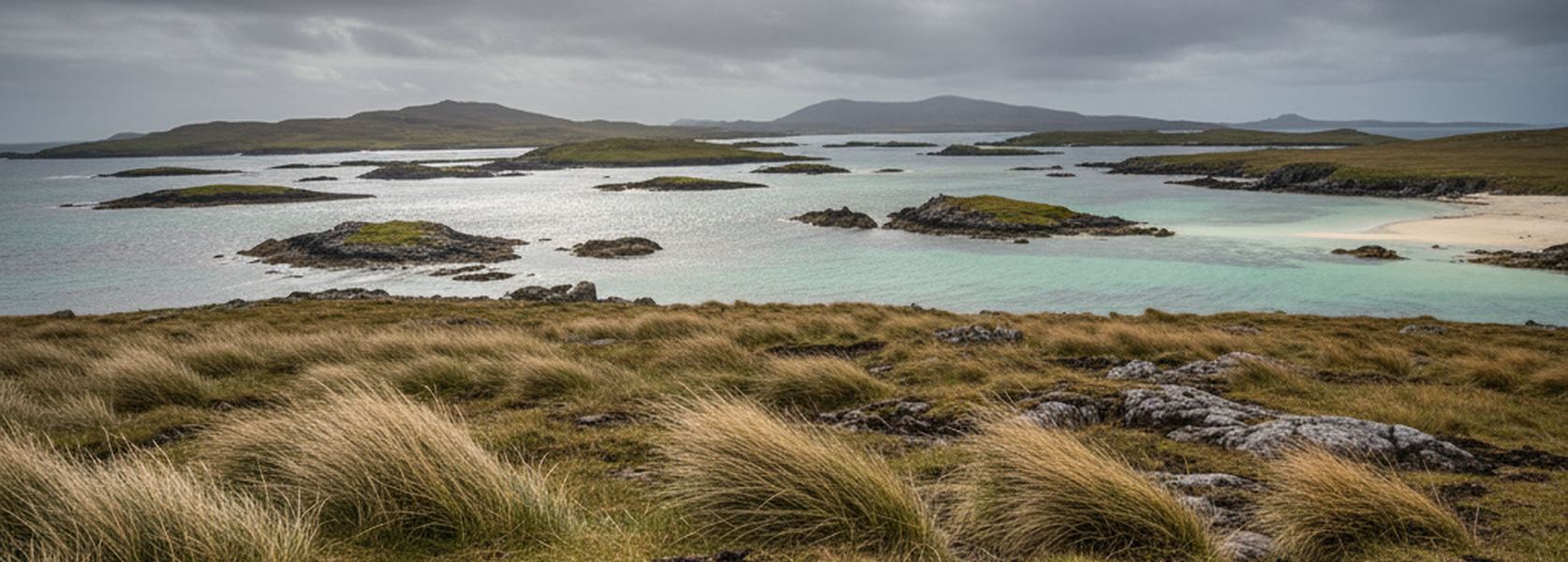
The chain runs south to north. Two nights on Barra, where the ring road is fourteen miles and the causeway to Vatersay dates from 1991; the cockle sand at the north end is firm enough to be used as a landing strip at low water. A forty minute crossing to Eriskay, a causeway of 2001, and one night on South Uist with machair on one side and hills on the other.
Two nights in the Uists follow, joined by causeways rather than boats: more loch than land, with a chambered cairn on the hill above the road. One night on Berneray, three miles of west facing sand, then an hour across the Sound of Harris, threading a marked channel between reefs into Leverburgh.
Two nights on Harris buys the east coast road through the Bays, twenty miles of single track over bare rock, and the west side, where the sand at Luskentyre runs a mile at low tide. Two nights on Lewis takes in the standing stones at Calanais, raised around 2900 BC, the broch at Carloway still nine meters high on one side, and the restored blackhouse village on the coast below it. Then south again and an hour and forty minutes of water to Skye for the last bed. About 300 miles of driving in all, most of it under 40 miles an hour.
Weather, light and the ground
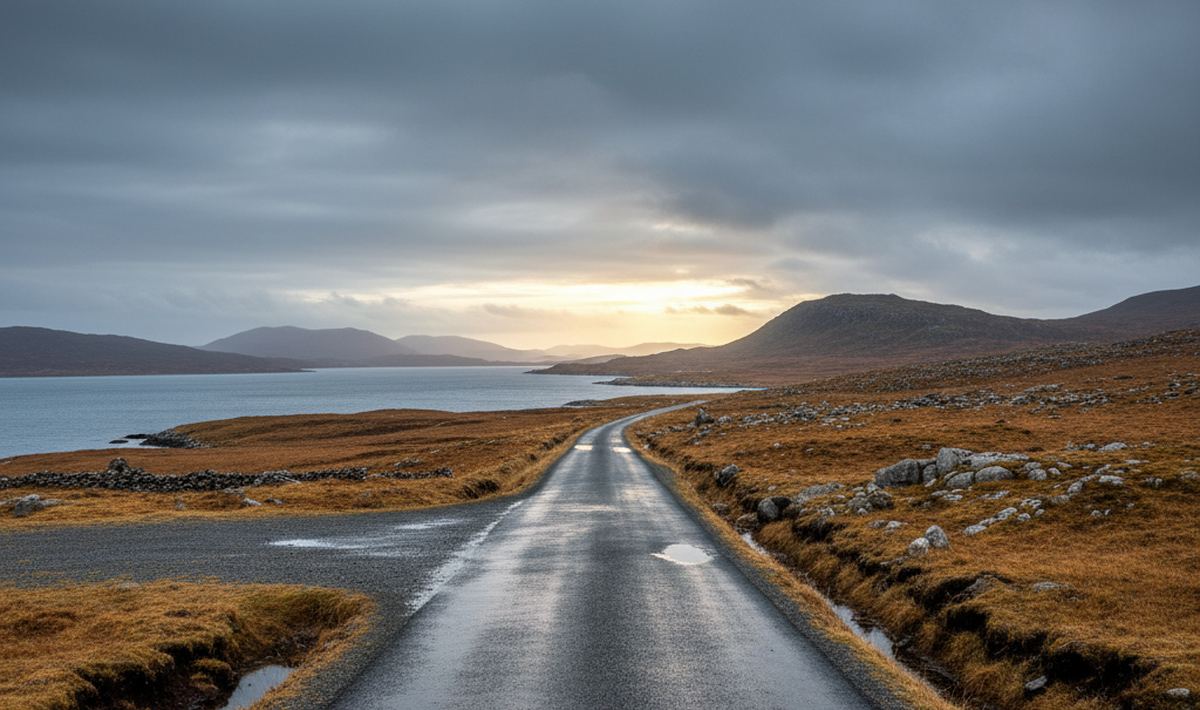
Stornoway records about 1,100 millimeters of rain across roughly 250 days a year, which reads worse on paper than it feels: the rain arrives in twenty minute instalments carried sideways by wind, and then the light comes back. July daily maxima sit around 16C, or 61F. The sea holds 12C to 13C in August and people swim in it anyway. Gales are mostly an October to March business, but a day of force six in June will close a shallow crossing and end a picnic.
Light is the thing nobody plans for. At 58 degrees north in mid June the sun is up before half past four and down after ten, and it never goes properly dark; you can walk a beach at eleven at night. By late September you have twelve hours of daylight and a fair chance of a still, clear morning.
Underfoot it is peat, gneiss and shell sand, often within fifty meters of each other. Machair, the grassland that grows on wind blown shell sand, flowers from late May into August. Midges want still, damp air, so they are a nuisance in a sheltered hollow at dusk and rarely one on an open beach. On Lewis and Harris a good many shops and some fuel pumps are shut on Sunday; buy food on Saturday and treat the day as walking.
What the price covers, and what it does not
From $3,180 per person covers the eleven nights across the seven beds and a small car for the eleven days, with this office's work folded in. It is a May or late September figure. Mid July runs above it, because beds, not miles, are the scarce thing on these islands.
Outside it: the four ferry crossings, which you buy in your own names direct from the operator, since this office arranges no carriage by sea or by air and holds a contract with no carrier; your own travel to and from Scotland, which is yours and stays yours; fuel, at roughly 300 miles and island pump prices; and food, apart from the two houses that will cook an evening meal if you ask the day before.
Money does not run through this desk. Each house and the car firm settles with you on their own paperwork, at their own counter or by their own account, and this office is paid a commission afterwards by whoever took the reservation. No card details reach us, nothing is deposited here, and the final figures are confirmed by the people providing the rooms before you commit to anything.
Seven arrivals, and the traveler this is wrong for
It suits someone who can drive a narrow road with passing places and blind summits, on the left, in rain, and reverse a hundred yards without resentment. It suits people who do not mind unpacking seven times, eating at seven because the kitchen closes at eight, and reading a tide table before deciding what a Wednesday is for. It suits anyone who wants the country to change every day: sand, then bog, then rock, then a town of six thousand with a chandlery and a map shop.
It does not suit a schedule with no slack in it. If you have to be on a plane by Friday morning, the eleventh night belongs near the mainland, and we will say that before you reserve anything at all. It does not suit anyone who needs a step free room or a lift; four of the seven houses have stairs, and two have doorways built for shorter people in colder times. It does not suit a traveler who wants dinner at nine, a choice of six kitchens, or a pool. And if what you actually want is one house and day trips out of it, this is the wrong shape of week; say so and we will put a different one in front of you.
Short answers to the usual doubts
Can you reserve the ferry crossings for us?
No. This office arranges no carriage by sea or by air and holds a contract with no carrier, so all four crossings are yours to buy, in your own names, direct from the operator. What we do instead is tell you which sailing each bed is built around, how far ahead the vehicle deck tends to fill for your dates, and what the tide does to the Sound of Harris timetable from one day to the next. Buy the crossings first, send us the reference numbers, and the beds are arranged around them.
Why does any of this still need a telephone call?
Because four of the seven houses appear on no reservation platform at all, and two of those four keep a rule they will discuss but not display: Saturday to Saturday in July, three nights minimum in May, nothing taken until you arrive. One answers a landline for about two hours in the evening and not otherwise. A form cannot ask whether the room with the low doorway happens to be the one going spare on the ninth, and an email sent in March may sit unread until its owner comes off the boat.
What happens if a crossing is canceled?
It happens. Wind and swell close the shallow crossings more often than the long ones, and the boats working these routes are not new. Plan on the possibility once across eleven nights. The route is built with one loose night in it, and we keep the telephone number of every house on the list, so a night can usually be pushed a day rather than lost outright. You pay for the bed you actually sleep in, the operator deals with the ticket, and nobody can promise the water will behave.
Do we need a car?
For this shape of week, in practice, yes. Buses run the spine roads of the Uists and the main roads on Lewis and Harris a handful of times each weekday, thinly on Saturday and hardly at all on Sunday, and they do not pass most of the beds on this route. A small car is inside the price. It should be one you are content to reverse a hundred yards into a passing place, because on the east coast road in Harris and across much of Barra that is simply what driving is.