On the Ría de Arousa you can reserve a nine night stay in a working Galician port
The honest part first. You could arrange most of this yourself: the flat is on the open market, the coach runs all day, and nobody stops you walking out onto the pier. What is awkward is the timing, which moves with the fleet. If that suits you, reserve a nine night stay in a working Galician port and let the office take the two telephone calls.
- Starting figure, per person
$2,140
- Nights
- 9
- beds you will learn
- 1
- Country
- Spain
- How much of this you could arrange without us
- you could arrange most of it yourself
Confirmed as a final figure once the supplier holds the dates. Getting to the country is not included.
- Whatever is agreed comes back to you in writing from the supplier, before any money moves.
- No card is asked for on this site and none is stored: the supplier takes payment on its own terms.
- A request sent through the form is answered in writing within one working day.
What you could do here without us
Start with the number this catalog is sorted on, because it is the part most pages leave out. You could arrange most of this yourself. The flat is listed on the open market and takes a card. The coach from the airport at Santiago runs several times a day, takes a little under two hours and costs under ten euros. The town is small enough that by the second morning you will have found the bakery, the ice plant and the two bars that still serve food at ten at night. Nobody guards the pier; walking out along it asks nobody's permission.
Two things are awkward, and they are why this page exists. The sale times move with the fleet rather than the calendar, so a week planned in March against last season's hours puts you on the pier at the wrong end of the day. And standing where you can see the sale properly is arranged by asking a person whose telephone is answered between eight and nine in the morning, in Galician or in Spanish, who has no particular reason to say yes to a stranger. That is about a fifth of this week. The rest is yours. If you are comfortable in Spanish and do not mind a call that opens with an apology, do the whole thing without us and keep our number for those two dates.
One bed, nine nights, thirty four steps
This week sits in the shortlist for staying put, with a town you can walk to, which in practice means one key and one bed for all nine nights. The flat is on the first floor of a 1970s block on the hill above the port road: one bedroom, a bathroom off the hall, a kitchen with a two ring hob and a knife that cuts, and a balcony with a drying rack that will hold everything you brought. There is no lift and thirty four steps to the door. The walk down to the fish dock is eleven minutes and the walk back up is fourteen, and by the third day you stop counting.
From $2,140 per person covers the nine nights, the linen, the clean at the end, and the two arrangements the office makes at the hall. It does not cover getting to Spain, a car, or a single plate of food. Two people who eat in bars and cook at home twice will spend something in the range of 55 to 75 euros a day between them, and rather less on the days the fish comes home in a bag from the counter at the end of the pier, which it should at least twice.
The auction hall at the end of the pier
The hall is a long concrete shed with a roller floor and high windows, and for most of the day it stands empty and hosed down. It fills twice. The day boats come alongside in the late afternoon and their boxes cross the floor from about five; the boats that stay out arrive before dawn and that sale runs closer to six in the morning. Neither hour is fixed. Wind, a poor haul or a slow unload moves the whole thing, which is why the office rings the week before you fly and again on the day you land.
What crosses the floor depends on the month: small sardines from June, horse mackerel and mackerel through the summer, octopus, blue whiting, hake off the longliners, and a scattering of things with no English name at all. It goes in stacked plastic boxes on ice, sold in lots on a falling price, the number dropping on a screen until somebody stops it, in a room where nothing is explained to anybody. There is no sale on Sunday and, some weeks, none on Saturday either. Nine nights is chosen so that a blank weekend and one blown out day still leave you five or six sales, which is more than anybody needs.
Days you fill yourself
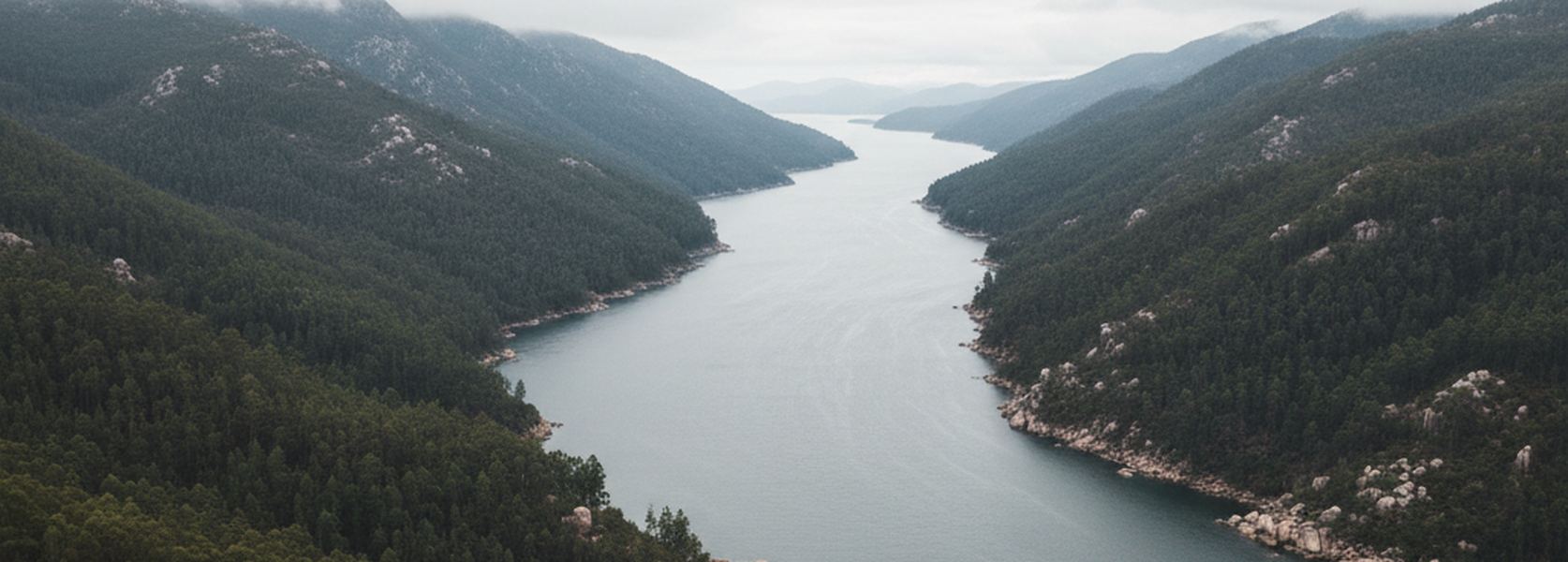
Twelve kilometers south the coast turns to sand and a moving dune walks inland a meter or two a year, about a kilometer of it, some twenty meters high at the crest, with a salt lagoon on one side and a freshwater one on the other. The boardwalk takes an hour and a half at a slow pace. Eight kilometers inland a granite dolmen stands in a field behind a gate you open yourself, raised somewhere in the fourth millennium BC and left largely alone since. Sixteen kilometers up the inlet a road climbs to a viewpoint at 498 meters, and from it the whole ría lies out below with several hundred mussel rafts on it, set like floorboards.
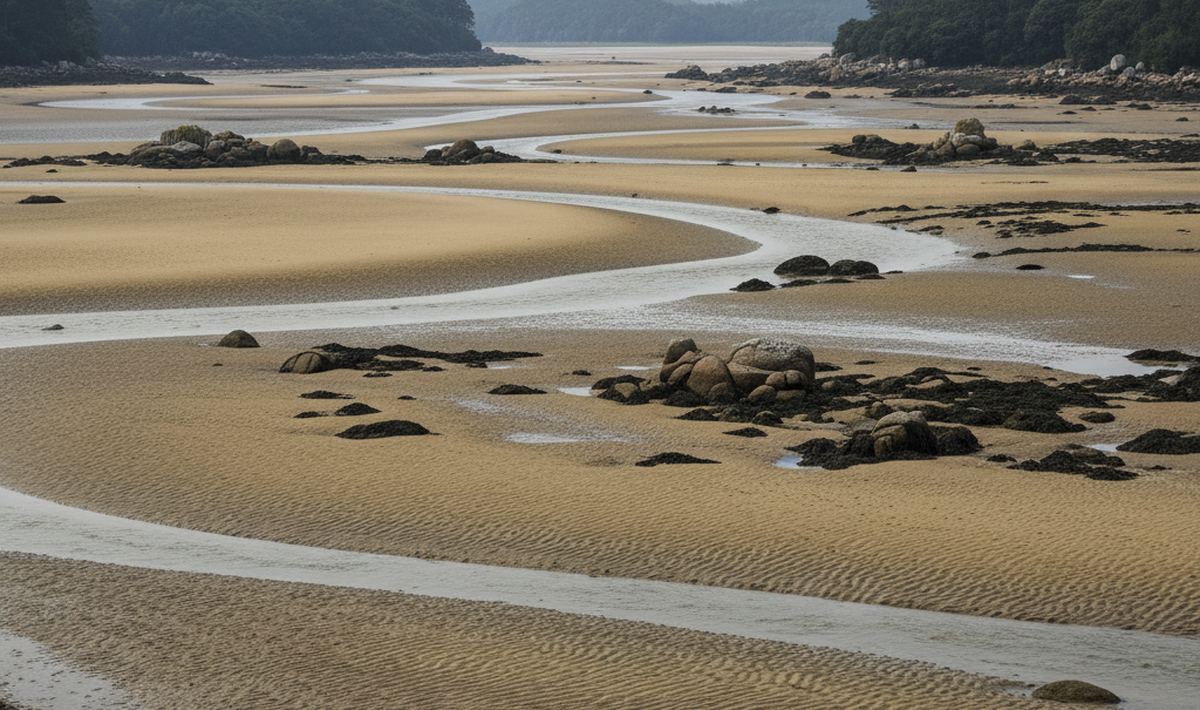
Then there is low water. The spring range here runs to about three and a half meters, and on the big tides the flats off the town go bare for ninety minutes at a stretch while licensed gatherers work them with rakes, to a daily limit in kilos set by the shellfish plan. You watch that from the wall. You do not walk out onto it. Swimming is realistic from late June into early October, about 18 or 19 degrees in September, green rather than blue, with a pull on the ocean side that the town beach does not have.
Rain, hill, and who this does not suit
It rains. Between May and October reckon on three or four wet days in nine, and outside those months on more. The rain arrives from the west in a wall, sits for a morning and then stops as though a tap has been shut, and the wind on the pier in October will take a hat off your head. The hill to the flat is steep enough to be a decision when you are carrying two bags of ice and a kilo of clams. Nothing here smells of nothing: the dock smells of the dock and the hall smells of the hall, and both are two hundred meters from where you sleep.
This suits people who like being somewhere with work to do that is not being done for them, who can spend a morning watching one thing, and who can eat at Galician hours, which means kitchens at two and again at nine. It does not suit anyone who needs a lift, anyone traveling with a child who will not sleep through a lorry at five in the morning, or anyone who wants a beach fortnight with a port as the backdrop; the swimming is fifteen minutes out of town and the town is not arranged around it. If what you want is a pretty harbor, say so and the office will point you at a different week. There are five of those in the catalog and this is not one of them.
Short answers to the usual doubts
Can you get us out with the boats for a night?
No. Not on a working boat, not for a night, not for an hour. Those crews are paid on shares and sail to a plan that has nothing to do with visitors, and a skipper who says yes is doing a favour he will regret at three in the morning. The office will not ask him. If you want to be on the water, small passenger boats run out over the mussel rafts from the towns along this inlet between June and September, and that is a different thing altogether. You buy that ticket yourself and it takes about ten minutes. Nothing that floats and nothing that flies is arranged from this desk, so we would only be standing in the queue on your behalf.
Do we need a car for nine nights?
Not for all of it. The flat, the pier, the food, the wall where you watch the tide and the coast path north are all on foot. The dune, the dolmen and the viewpoint at 498 meters are not: either you take the local bus and accept that it goes twice a day, or you hire a car. Most people who stay nine nights hire one for three days and leave it parked for the rest of the week. On this particular week we stay out of the car, because the desks at the airport are a form and a card, and we would only be putting a hand between you and a page that already works.
What is in the price, and how is the office paid?
From $2,140 per person covers the nine nights in the flat, the linen, the clean at the end, and the two arrangements at the hall. It does not cover getting to Spain. Nothing that moves you by air or by water is arranged here, and we hold an agreement with no airline and no shipping line, so your flights are yours, in your name, bought where you please. Food, a car and any ticket for the water are yours as well. Nothing is paid to us at any point and we never see a card number. The flat pays us weeks after you have gone home, at a rate it fixed itself.
What happens if it rains for most of the nine days?
It might, and the price makes no allowance for weather, from us or from anybody else. It comes in from the west in a wall, sits for a morning, then stops as though a tap has been shut. The hall works in the wet, which is rather the point, and so does the tide. The dune in low cloud is a different walk from the dune in sun, and the boardwalk will be yours alone. But we do not promise you a dry week, and if nine days with rain in them would sink the trip, take a week from another part of the catalog.