Nine nights, one bed, and what it takes to book a lake town week in Carinthia
You could arrange all of this yourself, and the office would rather say so early. Nine nights in one bed, a lake 141 meters deep at 588 meters above the sea, a town of 3,300 people you can cross on foot in twenty five minutes. Book a lake town week in Carinthia, or reserve it direct and keep the number for a week that fights back.
- Starting figure, per person
$2,410
- Nights
- 9
- beds you will learn
- 1
- Country
- Austria
- How much of this you could arrange without us
- you could arrange all of this yourself
Confirmed as a final figure once the supplier holds the dates. Getting to the country is not included.
- Whatever is agreed comes back to you in writing from the supplier, before any money moves.
- No card is asked for on this site and none is stored: the supplier takes payment on its own terms.
- A request sent through the form is answered in writing within one working day.
You could arrange all of this yourself
This is the first of the four steps the catalog sorts on, and it is the step where the office is not needed. Nothing here is held back from you. Houses on the north shore take reservations direct, in German and in English; the boat timetable is a public document that changes twice a season; the bus from the railway station 10 kilometers away runs on a published timetable and costs a few euro. Two evenings with a map and a browser and you will have the same nine nights at roughly the same figure, with a room you chose yourself.
So reserve it yourself. What Etre Super Travel would still be for is narrow, and worth stating narrowly: the questions have already been asked once. Which rooms look at water and which look at the road behind. Which houses shut the kitchen at 20:00. Which weeks the boat runs a reduced timetable because the schools have gone back. Asking costs you nothing, because a supplier pays the commission after you travel and no money moves between you and the office at any point. And if the week cannot do what you want, you get told so in one sentence rather than three.
Where you would actually be
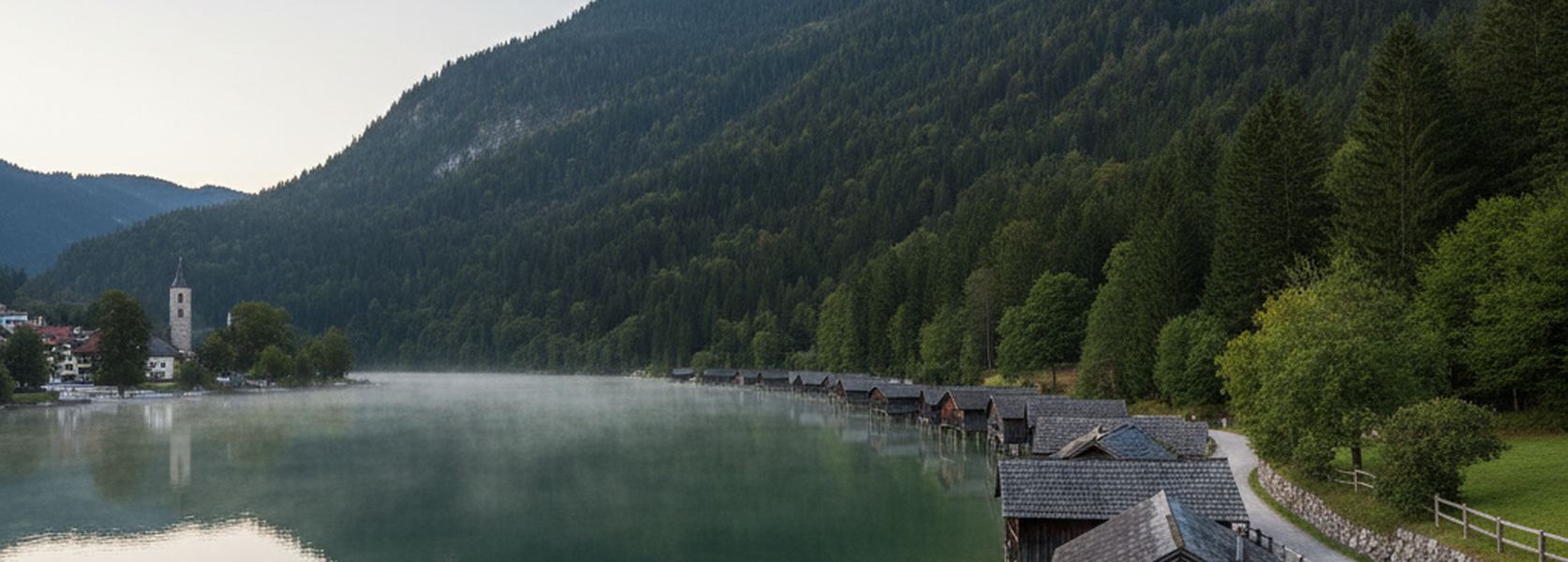
Carinthia is the southern end of Austria, pressed up against the ridges that close it off from Slovenia and Italy. The lake lies at 588 meters, about 11.5 kilometers long and not much more than 1.5 kilometers across, 13.3 square kilometers of water that goes down 141 meters in the middle. Deep enough to stay cold underneath all summer, shallow enough at the edges to be warm by the middle of July.
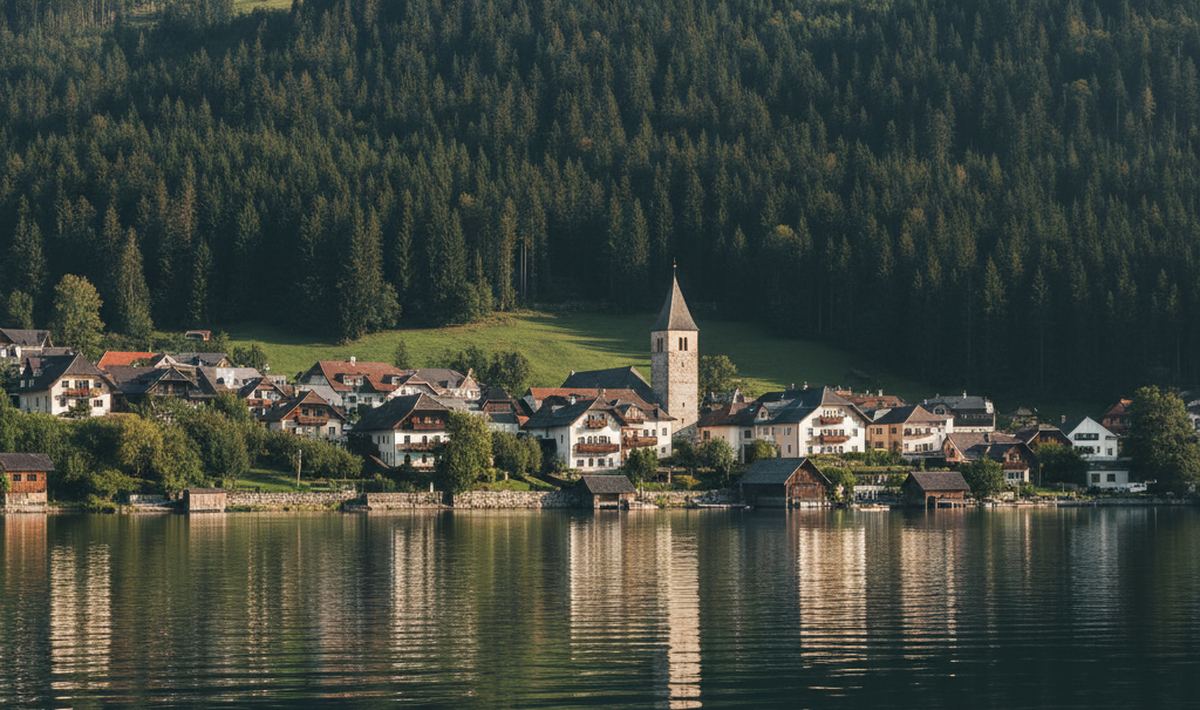
The towns are all on the north shore: one at the west end, one at the east end, and the one you would sleep in between them, about 3,300 residents, an abbey courtyard founded around 1070 with old lime trees in it, and a path that runs along the water. The south shore has a single narrow road, a scatter of houses and a great deal of forest. Behind the town the ground gives up being flat at once: from the water at 588 meters to the ridge of the alp near 2,000 meters in about six kilometers of map.
Distances that matter. The railway station at Spittal an der Drau is 10 kilometers away, on the line north to Salzburg, about two and a half hours by train. Villach is 45 kilometers by road, Klagenfurt about 70.
Nine days, one bed
Unpacking once is the whole idea. A plausible nine days runs like this. Three or four of them have no structure beyond a towel, a swim at 07:30 before anyone else is in the water, bread from the bakery, and an afternoon under a tree with a paperback. Two are flat walking days: the shore path goes about five kilometers west to the next town and rather less east, and the passenger boat lets you go out one way and walk back, from late April to October.
Two are mountain days and they are real ones. A road climbs from the town to the high pastures at about 1,800 meters, and from the parking area a ridge walk gives four to six hours with roughly 400 meters of ascent and the lake laid out below you the entire time. The other goes up a side valley to the west, a toll road of some 14 kilometers of switchbacks that ends under a dam wall 200 meters high at nearly 1,900 meters; it opens in May and shuts with the snow in late October.
That leaves one day for the walled town 25 kilometers up the valley, or the Saturday market in Spittal, which is packed away by noon.
The weather, and the half of the day that holds
July and August run 26 to 28 C in the valley and 13 to 15 C at night, which means an open window and a blanket on the bed. The pattern to plan around is convective. Mornings are usually clear, cloud builds over the ridges from about 13:00, and thunderstorms arrive between 15:00 and 18:00, often hard and short. Anything high should start at daybreak and be down off the ridge by early afternoon. July delivers something like 130 millimeters of rain across twelve or thirteen days, nearly all of it in those afternoon falls.
The water is the reason for nine nights rather than four. It reaches 25 or 26 C in the last week of July and sits there through August, and because a body of water that deep gives its heat back slowly, the first half of September still swims at 21 or 22 C with the air at 18. Before the middle of June it is a plunge rather than a swim, around 16 to 18 C.
The hard part is plain enough. Nine nights in one small town, and if three of them are gray you are still in one small town. The food shop shuts at 18:00 on weekdays, at 17:00 on Saturday, and does not open on Sunday at all.
What $2,410 covers, and who should not come
From $2,410 per person: nine nights, a room with breakfast in a small family house within walking distance of the town, on dates between mid June and mid September. The figure is a starting point and the house confirms it before anything is held. Nothing is charged by the office at any stage and no card details ever reach it.
Not in the figure: your own flights, which stay yours; a hire car if you take one, which in high season runs 45 to 60 euro a day plus fuel; the per person per night local tax the house adds at the end, a couple of euro; every meal after breakfast; boat and lift tickets. You settle with the house at its own counter on the last morning, in euro.
It suits people who unpack once, swim daily, walk between eight and fifteen kilometers without holding a discussion about it, and can spend an afternoon reading. It does not suit anyone who wants a different town every second night, anyone who needs to get home from somewhere at 23:30 in a place where the last bus went long before, or anyone who wants to be talked into it.
Short answers to the usual doubts
You have told us to reserve it ourselves. What would we actually be paying you for?
Nothing, and that is not a turn of phrase. Etre Super Travel takes no money from a traveler at any point; a supplier pays it a commission after the fact, or it earns nothing on the week. What you would be using is questions already asked once: which rooms face the water and which face the road behind, which houses shut the kitchen at 20:00, which weeks the boat drops to a reduced timetable. If you would rather ask those yourself, ask them yourself. You will get the same answers.
Do you arrange the flights?
No. The office arranges no carriage by air or by sea, holds a contract with no carrier, and cannot sell or promise you a seat. Your flights are yours to reserve and yours to change. Most people land at a large airport two to three hours out and come the rest of the way by train to the station 10 kilometers from the town, then by bus or taxi. Tell the office the day and hour you land and the nine nights are built around it. That is the whole of our involvement with the airplane.
Do we need a car for nine nights?
For six of the days, no. The town is about twenty five minutes end to end on foot, a bus runs to the railway station several times a day, and the boat works the lake from late April into October. For the two mountain days, yes: the high pasture road and the toll road up the side valley are not served by anything you would want to build a day around. A common answer is to hire a car for three days in the middle of the nine and hand it back.
How cold is the water, honestly?
In the second half of June, roughly 18 to 21 C: swimmable, brief. By the last week of July the surface sits at 25 or 26 C and stays there for about five weeks. September holds 21 or 22 C in the water while the air falls to 18, so you swim in warm water on a cool day, which some people like and others find bleak. Before mid June it is a plunge and nothing else. These are surface figures; three meters down it is another matter all summer.