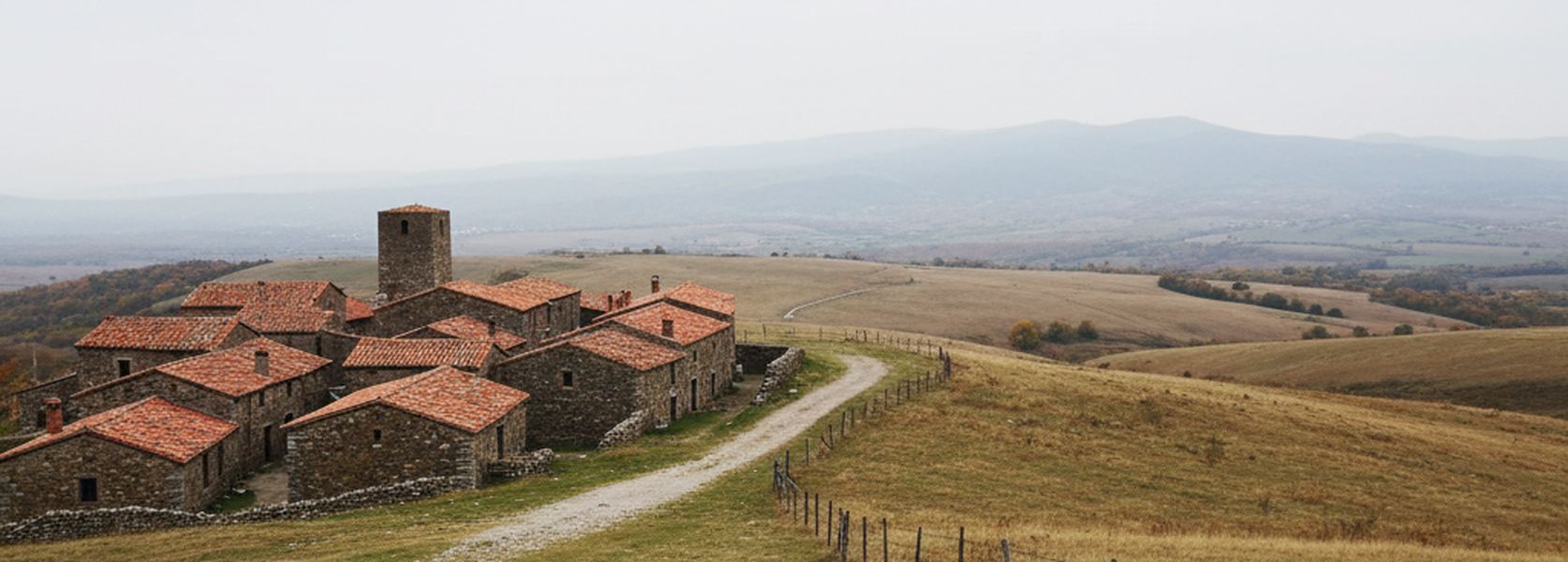
The fifty meters past the front door decide whether you reserve a stay within walking distance of a town
Two answers are already behind you. The week is yours to pick, and you would rather unpack once and stay put. What is left is the ground under the window: whether you reserve a stay within walking distance of a town, or take a week where the nearest bread is a drive away. It changes more than it sounds as though it should.
Why the ground under the window is settled before the country
People arrive at a reservation with a country in mind and a picture of a building. Neither of those settles the week. What settles it is the fifty meters past the front door, because that is the piece of ground you meet forty times between one Saturday and the next, in your socks, at eleven at night, in the rain, when the coffee has run out.
Answer this and the shortlist collapses. There are thirty-two weeks in the catalog. Two questions are already behind you, and this third one leaves four. Not four we think you will like. Four that survive the three answers you have given. Handing an adult a list of thirty-two and calling it a choice is a way of not doing the work, and we would rather do the work.
There is no correct answer here, only the answer you will still be glad of on Wednesday afternoon, when the weather has closed in and the day has quietly canceled itself. That is the hour when the two doors stop resembling each other.
What each answer costs by Thursday
Door A, a town you can walk to. Bread before eight. A chemist. Somewhere to eat on the night nobody wants to cook. A bus that goes somewhere, even if it goes there twice a day. Other people's evenings coming through the window, and their cars at seven, and a delivery lorry reversing into the square on the one morning you wanted to sleep. A car stops being necessary, which removes a cost and a daily decision at the same time.
Door B, nothing within walking distance. A dark that has stars in it. A single track lane. A day that belongs to the house in a way it cannot when there is a street outside. Also one food shop for the whole week, done on the first afternoon or arranged before you arrive; a car that is not optional; a twenty minute drive to replace anything you forgot. If one person in the party does not drive, that person is not going anywhere alone for seven days. Worth saying out loud now rather than discovering it on Tuesday.
What changes in the catalog once you answer
Every week we hold carries one number: how much of it a person could have arranged without this office. Four steps, from all of it yourself to it does not exist without an introduction. Your answer to this question moves that number further than anything else in the tree.
Say yes to a town and most of what comes back sits at the do it yourself end. Apartments over a square, a house on a lane with a bakery at the end of it, rooms round a courtyard: listed, priced and open to reserve at eleven at night by anybody with a card and an hour. Expect one or two of your four weeks to be marked as weeks you should reserve yourself, with the type of place named and where such places are listed. Forwarding an email and taking a commission for it is not work, and we would rather say so.
Say no town and the number slides the other way. Houses with nobody at a desk, a caretaker who answers a landline between certain hours, a track a hire car will not thank you for, a cook arranged for two evenings because the alternative is driving back after dark on an unlit road. That is the half where a telephone call does something a web form cannot, and where a mistake costs a day rather than money. The day is the part people underestimate.
Asked before you commit
How far is walking distance, in practice?
About twenty five minutes each way, on a surface you would use at night, in the rain, carrying a bag, without a torch. That last condition rules out a good many places that look walkable on a map. If a house sits one kilometer from a village and the kilometer is a grass verge on an unlit road with no pavement, we file it under door B and write down why. The measurement that matters is not the distance. It is whether you would do it twice in one day.
Can I answer this and then change my mind?
Twice over, if you want. The tree is three questions long and takes under a minute to walk again, nothing is held while you decide, nothing is reserved, and no card details are involved at any point. Readers do turn round on this one, generally on finding that the thing they said they wanted is not the thing they want. If you would rather see both branches at once, ask for both, and you will get four weeks from each side with the differences written out instead of argued.
Does the office lean toward one of the two doors?
No, and the incentive runs the wrong way for it. Weeks behind door B usually take more work from us, which is where a commission is actually earned. Weeks behind door A frequently take none, and the week itself says so, in the number printed against us. If we were steering you, it would show up there first. The two doors produce different weeks, not ranked ones, and the only person who knows which of them you will actually live in for seven days is you.